
Return to Play
Warriors vs Worriers
Return to Sports
Returning to sports after ACL surgery requires time for the new ligament to mature and get strong. In addition, muscle strength and power and neuromuscular coordination need to be restored. Each of these factors may need at least 9-12 months to be at relatively safe levels. A fourth factor, the psychological readiness to return to sports, can often take longer than the 9- 12 months.
The psychological readiness can be influenced by the other factors. If an athlete feels weak and uncoordinated, they often (but not always) feel like they are not ready from a psychological standpoint to return to competition. How an athlete handles stress can affect their psychological readiness.
COMT gene
Enter the COMT gene, or the Warrior/Worrier gene. The COMT gene provides the code for making the enzyme Catechol-O-Methyl Transferase (COMT). COMT enzyme breaks down the catecholamine neurotransmitter dopamine (along with epinephrine and norepinephrine) in the prefrontal cortex of the brain. The prefrontal cortex is the part of the brain responsible for executive function which includes decision making, problem solving, self-control, working memory, and planning. The prefrontal cortex performs it’s best when dopamine levels are maintained in a certain range; too high or too low and executive function declines. Stress increases dopamine levels in the brain and COMT breaks down the dopamine to try and maintain the optimal level.
Continue Reading...
The warrior versus worrier concept is based on the type of COMT enzyme found in each individual. Each enzyme is comprised of a pair of subunits. These subunits can have either a methionine (Met) amino acid in their structure or a valine (Val) amino acid. Our genetic code, that we inherit from both parents, determines which combination of subunits we end up with. The possible subunit combinations for the COMT enzyme are Met/Met, Val/Val, or Met/Val. The Met form of COMT has a lower activity level for breaking down dopamine compared to the Val form. Val/Val has 3-4 times greater COMT activity as compared to Met/Met. The Val/Met heterozygote has intermediate levels of COMT activity. This means that the Val/Val types will break down dopamine faster than the Met/Met types. During relatively calm times, dopamine is being produced in small amounts and the slower Met forms will do a better job at maintaining the dopamine levels in the optimal range. The Val forms may clear out the dopamine too quickly, resulting in dopamine levels dropping below optimal. In times of stress, dopamine levels may surge and the Val forms will be better at maintaining optimal dopamine levels
As you might surmise, those individuals with the Val/Val COMT are the “warriors” and those with the Met/Met COMT are the “worriers”, and those with a combination of Val/Met are somewhere in between in their response to stress. Approximately 25% of the population is either Val/Val or Met/Met and 50% is a combination (Val/Met). In a large group of athletes (like a college football team) there will be a wide range of how athletes handle stress.
There can be advantages and disadvantages for either type
From a practical standpoint, the Val/Val types (“Warriors”) perform better under stress. Because Warriors break down dopamine quickly, they need some stress in their life just to keep dopamine levels elevated to the optimum level. They may have an advantage in rapidly processing stressful stimuli. The Met/Met types (“Worriers”) need ways to decrease stress and decrease dopamine to the correct levels. Worriers have an advantage on tasks that require memory, complex planning and sustained attention. However, all of these responses to stress are also moderated by factors such as age, gender, ethnicity, and adverse life events (like an ACL injury)
Back to return to play after ACL surgery
Specific points need to be addressed for the return to sports after ACL surgery: time for graft maturation, muscle strength, neuromuscular coordination and psychological readiness. The Warrior-type may need the stress of competition to feel complete and may try to push to return to sports sooner than they are physically ready. For them, the sports are more important than the possible adverse consequences. The warrior athlete needs to be educated about the risks of early return. The education process needs to begin soon after the first diagnosis of the injury and repeated throughout the recovery process giving the athlete time to absorb the information. Parents of younger athletes need to step up and help protect their children from ill-advised decisions.
During the rehab process, the Warrior may be less pain sensitive than the Worrier and ends up pushing through pain that ultimately delays the overall progress. Again, early education helps the Warrior understand that pain will slow progress and potentially delay the return to sports. Warriors may need progressive short-term goals (challenges) to induce a reasonable amount of stress. More challenging tasks are also good for the Warrior.
The Worrier-type athlete does not want to get re-injured. It is important that these athletes understand that almost all athletes experience some degree of apprehension about returning to play. It is normal to be nervous. Worriers tend to do better when they are put in control of the situation. A well-planned progression in the rehab process can help the Worrier have less anxiety. Experience, or consistent exposure, will help slowly build confidence.
The Worrier tends to be more pain-sensitive than the Warrior. The advantage here is that the
Worrier will speak up before a problem gets worse. Assuring the Worrier that certain amounts
and types of pains are normal can help alleviate stress. Also, exercises can be modified to
minimize pain. The Worrier can also do more challenging tasks and have short-term goals, but
these need to be worked on more gradually.
The Warrior/Worrier mix gets to feel all of the advantages and disadvantages of each singular
type. Different environments and experiences will help shape your responses.
James Moore
Exercise Physiologist
Return to Sports After ACL Reconstructive Surgery
ACL injuries are the most common knee ligament injury in athletes. In cutting and pivoting sports, ACL injuries can account for 64% of knee injuries. For a safe return to sports, the recommended treatment for the ACL rupture is to reconstruct the ligament to eliminate instability in the joint. Without the ACL reconstruction (ACLR), the instability of the knee greatly increases the risk of subsequent injury to the menisci and articular cartilage. The long-term health of the knee joint depends on these structures.
Even with this information, some athletes may elect to not have the ACLR surgery and still continue to play sports. We at ISMI, and the general sports medicine community, do not advocate this as there is increased risk for continued knee instability and subsequent injury.
Often times, these are athletes who injured the knee just prior to their senior-year season (high school or college). If the athlete has ACLR surgery just a few months before the season was scheduled to start, the recovery will not be complete until well past the end of the season. These athletes will typically plan to have surgery at the end of the season, hopefully with minimal damage created during the season. Quite often though, the athlete finds that the knee is too unstable to play, and they elect to stop playing part way through the season.
After ACLR surgery, the return to sports depends on several factors:
- Length of time after surgery. The new ligament needs time to mature and allow it time to handle the loads created with sports. Bone bruises that occur at the time of the injury heal slowly and need time to fully heal. For cutting and pivoting sports, we prefer at least 9 months and ideally closer to 12 months before full return.
- Strength in the muscles around the knee and hips. Research shows that if quadricep and hamstring strength deficits are present, the risk of re-injury is increased. Strength deficits in the knee and hip muscles also contribute to altered mechanics when landing and stopping.
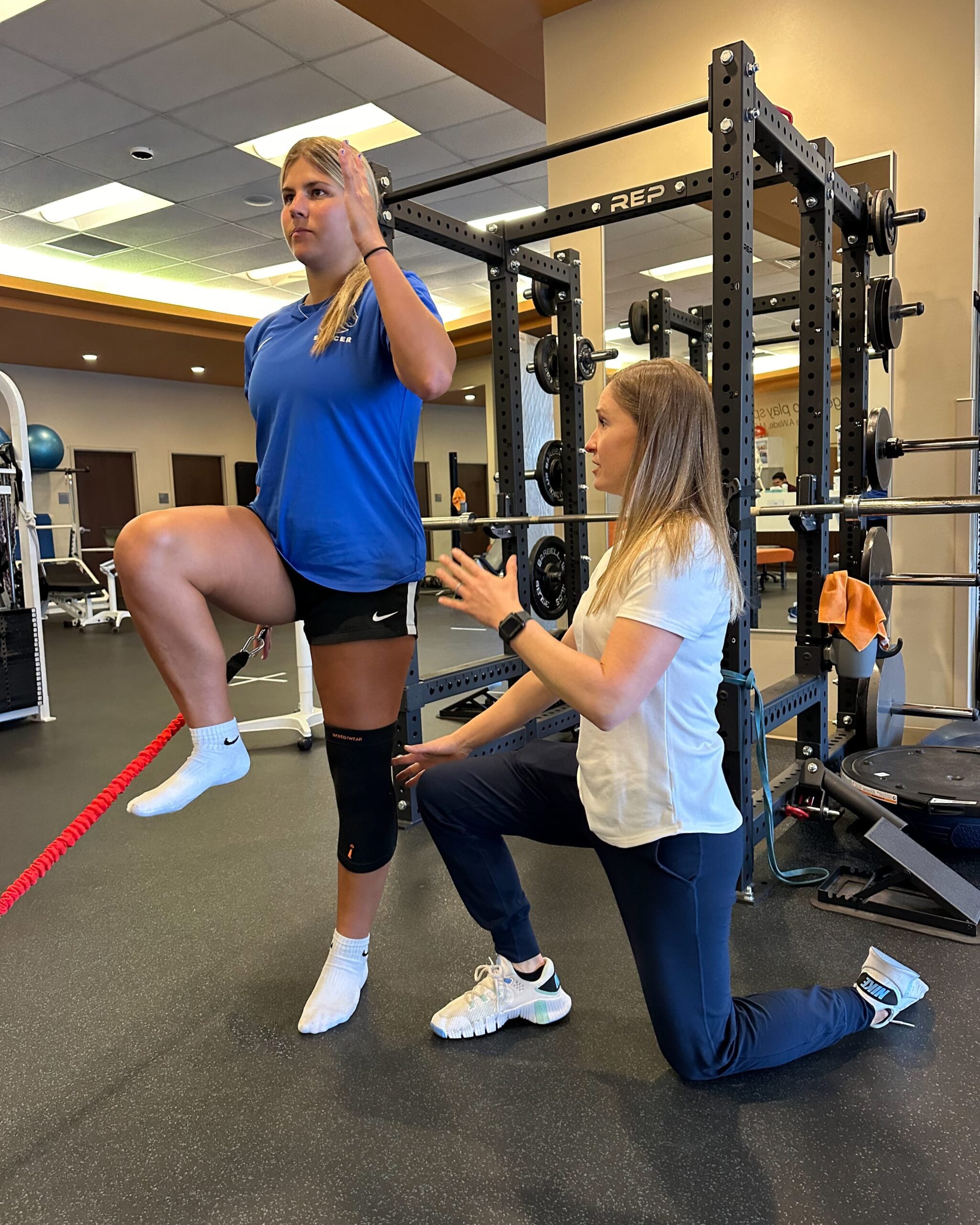
- Neuromuscular performance. Hop tests and agility drills can look at stability and coordination.
- Psychological readiness for full return. This may be the most important aspect in the return to sports, but perhaps is the most difficult to assess. Time, strength, neuromuscular performance, and a planned progressive return to sports all contribute to the psychological readiness.
These four factors will be discussed in depth in other sections. Read PDF Here
Time to Return After ACLR
When can athletes return to full activity?
Athletes can typically return to full activity once they have completed rehabilitation, regained pre-injury strength and range of motion, and demonstrated they can perform sport-specific movements without pain or compensation. This timeline is different for every injury and every athlete, which is why Idaho Sports Medicine Institute uses specific return-to-sport criteria rather than relying on a set number of weeks.
How long before returning to sports after an injury?
The timeline for returning to sports depends on the type and severity of the injury, ranging from a few days for minor bumps and bruises to many months for surgical repairs like ACL reconstruction. Rather than following a generic timeline, our providers track healing milestones and functional testing results against our return-to-sport criteria to determine when it is truly safe to return.